Ask any formulator who’s worked with copper fungicides long enough, and they’ll tell you copper hydroxide is the one that doesn’t burn your crop while it’s doing its job. That’s basically the whole pitch. Simple, but it took the industry a while to land on it.
So what is it, actually?
What Is Copper Hydroxide (Cu(OH)₂)?
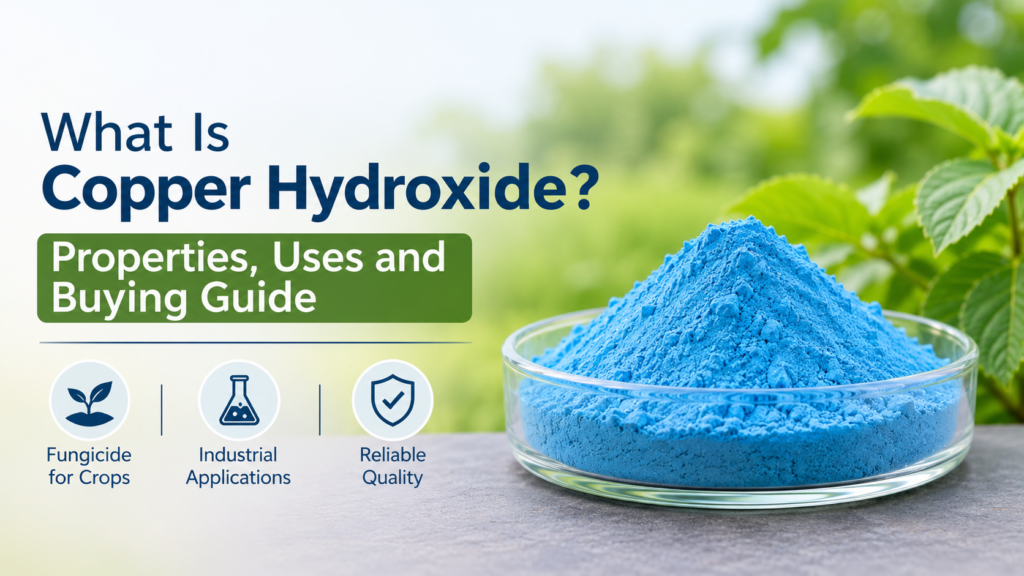
Copper hydroxide — Cu(OH)₂ — is an inorganic copper compound. Blue to bluish-green powder. CAS number 20427-59-2. Molecular weight around 97.56 g/mol. That’s the textbook answer.
Here’s the practical one: it’s a fungicide that farmers trust because it releases copper slowly instead of dumping it all on the leaf at once. Industry people use it too, mostly as a stepping stone to other copper compounds, or in pigments.
One compound, two very different worlds. Kind of unusual for an inorganic chemical, honestly.
Key Properties of Copper Hydroxide
Physical Properties
It won’t dissolve in water, not really. “Practically insoluble,” as the spec sheets like to say. Density sits around 2.8 g/cm³. It’s a fine powder, the kind that disperses into a spray tank rather than vanishing into it.
Chemical Behavior
Heat it up past a certain point and it breaks down into copper oxide. Under normal conditions though, it just sits there, stable, not reacting with much, not minding the shelf life.
Why This Matters If You’re Formulating
Particle size sounds boring until your spray mix separates in the tank. That’s all that counts then. A copper hydroxide manufacturer who controls particle size tightly saves you that headache later.
Copper Hydroxide Product Specifications
| Property | Details |
|---|---|
| Product Name | Copper Hydroxide |
| CAS Number | 20427-59-2 |
| Chemical Formula | Cu(OH)₂ |
| Molecular Weight | 97.56 g/mol |
| Grade | Agricultural / Industrial |
| Copper Content | Typically 50%–55% Cu |
| Appearance | Blue to bluish-green powder |
| Solubility | Practically insoluble in water |
| Packaging | 25 kg HDPE bags, fiber drums, or bulk |
| Shelf Life | Up to 2 years |
Grades of Copper Hydroxide
Agricultural Grade
Made for the field. Tuned so it sprays evenly and holds up on the leaf surface without scorching it.
Industrial Grade
Made for factories, basically. Feeds into pigments, other copper salts, specialty chemical runs.
Which One Do You Actually Need?
It depends on what you intend to use the product for. After all, a paint company and a mango plantation farmer don’t need the same bag, regardless of what the label may say. Just be sure to ask before ordering!
How Copper Hydroxide Works as a Fungicide
Here’s the mechanism, in plain terms. The compound sits on the plant and lets go of copper ions a little at a time. Those ions mess with the fungal cell’s enzyme processes, basically shutting down its ability to spread. Slow release, less leaf damage. That’s the trade copper sulphate doesn’t quite give you.
Industrial and Agricultural Uses
In the farms: downy mildew, blight, and various bacterial infections of fruits, vegetables, and plantation crops.
In fertilizers: a source of copper, mixed in.
In industries: dyes, paints, algaecides used for water treatment, and as an input to synthesize other copper compounds.
B2B Buying Criteria for Copper Hydroxide
Buyers check copper assay first. Always. Then they look at release rate, whether it fits their crop or their formulation.
Documentation and Batch Consistency
No COA, no deal, basically. MSDS too. And batch consistency, the kind you only find out about after three or four orders with the same copper hydroxide supplier in India.
Safety, Handling and Compliance
Trained hands only. PPE, always, dust masks especially — you don’t want this in your lungs. Store sealed, cool, dry, away from anything it might react with. And check local pesticide regulations before field use, every time, not just the first time.
Why Source Copper Hydroxide from an Indian Manufacturer
This is where Vrik Pharma comes into the picture.
Vrik Pharma is based in Vapi, Gujarat, with its manufacturing facility running out of Sarigam GIDC. 18 years in the chemical business now. ISO certified and provides various inorganic and speciality chemicals to their customers in India, as well as some overseas locations. As a copper hydroxide manufacturer, the products include industrial and agricultural types of copper hydroxide, accompanied by COA and MSDS for each batch. If you are making a list of suppliers, verify the following.
Copper percentage, particle uniformity, documentation, and ability to scale up as your order increases.
A copper hydroxide exporter in India that’s used to shipping abroad tends to make the customs side less painful too. Less back-and-forth on documents, fewer surprises at the port.
Conclusion
Copper hydroxide does one thing really well: it lets go of copper slowly. That’s the entire reason it beats faster-dissolving alternatives on phytotoxicity, and it’s why the grade and the paperwork matter just as much as the chemistry behind it.
Need copper hydroxide for your next order? Request a bulk quote from Vrik Pharma and get pricing, specs, and documentation for your requirement.
Related Posts
- Understanding Ferrous Sulphate: Industrial vs Agricultural Grade Differences
Ferrous sulphate is a widely used compound across multiple industries, from agriculture to water treatment…
- Magnesium Sulphate Manufacturer Guide: Uses, Grades and Specifications
What Is Magnesium Sulphate? Say "magnesium sulphate" and most people picture Epsom salt on a…
- How Ferrous Sulphate Contributes to Plant Health and Soil Quality
Ferrous sulphate, also known as iron(II) sulphate, is an iron salt with the chemical formula…